Generator Sizing for Commercial Sites: Prime, Standby and Continuous Ratings Explained
 Amir Oboudi·November 23, 2026·6 min read
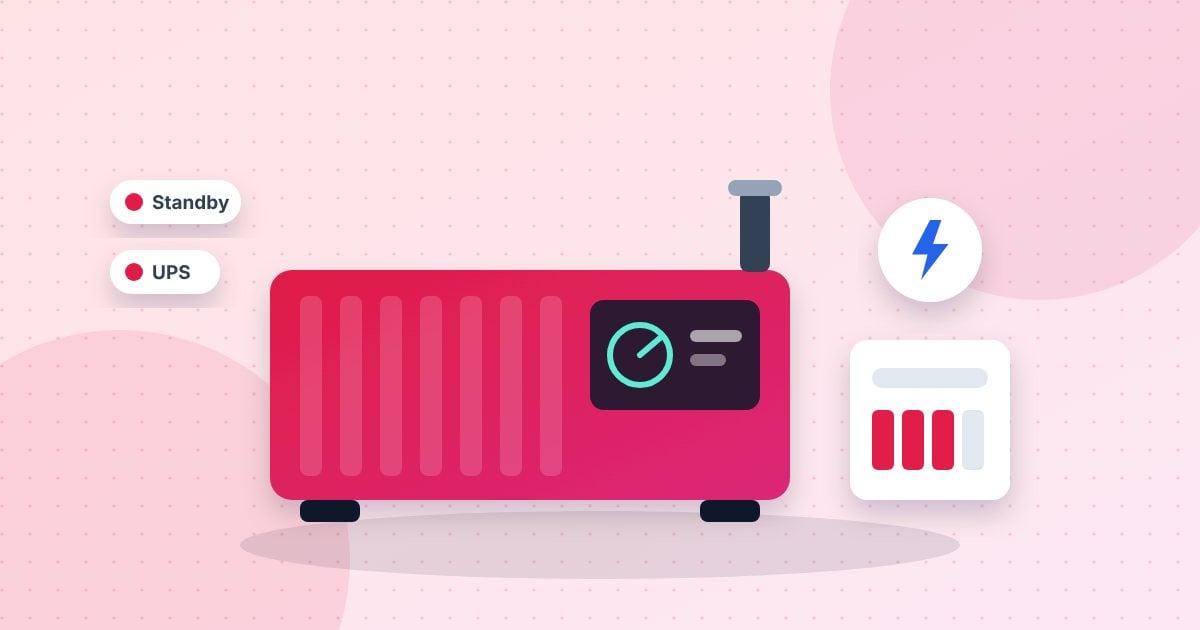
The kVA on the brochure is conditional. This guide explains ISO 8528 rating classes, how to build a load list, derating for heat and altitude, and the documents to demand before you buy.
In this article
Why the kVA on the brochure is not the kVA you get
A generator rated at a headline figure is rated at a set of conditions that are printed somewhere below it: an ambient temperature, an altitude, a power factor and a duty class. Change those conditions and the number changes. Most sizing mistakes are not arithmetic errors — they are comparisons between a rating measured one way and a load measured another.
ISO 8528 ratings, in plain terms
Generator ratings are usually expressed using the ISO 8528 power definitions. The three you will meet in commercial procurement are below. Wording varies slightly between editions, so get the manufacturer's own definition in writing on the quotation.
| Rating | What it means | Use it when |
|---|---|---|
| Emergency Standby Power (ESP) | Varying load for the duration of a utility outage, limited annual hours, no overload capability | The set backs up a grid supply and rarely runs |
| Prime Power (PRP) | Varying load for unlimited hours, with a defined overload allowance | The set is the primary supply, or runs long shifts |
| Continuous Power (COP) | Constant load for unlimited hours | Base-load duty, such as continuous process load |
A set sold as ESP is not the same machine as one sold as PRP, even when the kVA looks similar. Specifying the wrong class is how generators fail early.
Measure the load before you size the set
- Running kW and kVA, and the power factor. Generators are sized in kVA but loaded in kW. Confirm the power factor of your actual load rather than assuming a nominal figure.
- Motor starting. Motors draw several times their running current at start. One large motor starting can set the size of the whole set.
- Starting sequence. Size for the worst realistic step: the largest motor starting while other loads are already running.
- Non-linear loads. Variable-speed drives, rectifiers and IT loads distort the waveform. Ask about harmonic distortion limits and alternator derating.
- Future load. Note planned expansion now; re-rating later is far more expensive than buying headroom.
Derating for temperature, altitude and fuel
Output falls as ambient temperature and altitude rise, because the engine breathes thinner, hotter air. Manufacturers publish derating tables for exactly this. Ask for the table, then apply it to your site's design conditions rather than accepting the catalogue figure. If your site sits at altitude or the enclosure is tight, this step can change the required frame size.
Fuel, autonomy and refuelling
Autonomy is tank capacity divided by consumption at your expected load — calculate it at the load you actually expect to carry, not at nameplate. Then decide who refuels during an extended outage, how quickly they can get there, and whether the fuel is tested and polished on a schedule. Stored diesel degrades, and a tank that has sat untouched for two years is a reliability risk.
Noise, emissions and siting
Ask for sound pressure level at a stated distance — the distance matters, because a figure quoted at one metre is not the same as one quoted at seven. Confirm the enclosure rating for your climate, exhaust and air-path clearances, and the local bylaws or permit conditions that apply to your site. Siting decisions are much cheaper to change on paper than after the concrete is poured.
Single set or parallel
One large set is simpler and usually cheaper to buy. Two smaller sets in parallel give redundancy and better part-load efficiency, at the cost of synchronising gear and more controls to maintain. If downtime is expensive, the redundancy argument usually wins; if it is not, the single set does.
Documents to request with the quotation
- A datasheet with the rating class stated, plus the conditions it applies to.
- The derating tables for temperature and altitude.
- Factory test report for the specific unit, not just a type test.
- Certification documentation with a verifiable certificate number — see CSA, UL and IEC certifications.
- Warranty terms, including the service intervals that keep the warranty valid.
- Recommended spare parts and the lead time on each.
Red flags
- A single kVA figure with no rating class and no ambient temperature.
- ESP and PRP used interchangeably in the same quote.
- No derating table supplied, or one that stops at mild conditions.
- Sound level quoted without a distance.
- Motor starting ignored in the sizing calculation.
- A delivery lead time far shorter than the rest of the market, with no explanation.
Checklist before you order
- Build a load list with running kW, power factor and starting method for each item.
- Identify the worst credible starting step.
- Choose the rating class — ESP, PRP or COP — and write it into the specification.
- Apply derating for your site's temperature and altitude.
- Calculate fuel autonomy at expected load and name who refuels.
- Confirm sound limits and permit conditions with your municipality.
- Decide on redundancy, then price single versus parallel.
- Confirm freight, unloading and commissioning in the delivered cost — see shipping heavy equipment.
Where to go next
If the site needs ride-through rather than long outages, compare the options in backup power for commercial sites, and consider whether storage should carry the short events — see choosing battery chemistry. Verify the supplier before you commit with how to verify a supplier, and browse B2B listings and the shop.
This is general information, not engineering advice. Have a qualified engineer confirm sizing, electrical protection and code compliance for your site.
Frequently Asked Questions
What is the difference between standby and prime power?
Standby ratings assume limited annual hours during grid outages with no overload. Prime ratings assume unlimited hours under varying load with a defined overload allowance.
Can I use a standby generator as my main power source?
Not as rated. Continuous duty needs a prime or continuous-rated set; running a standby unit as a primary supply will affect life and typically the warranty.
Why does the generator need derating?
Because output drops as ambient temperature and altitude rise. The manufacturer publishes tables, and they should be applied to your site's design conditions.
How much extra capacity should I allow for motor starting?
There is no universal figure. It depends on the motor, the starter type and what else is running. Size against the worst starting step in your actual load list.
How much fuel autonomy do I need?
Enough to cover your expected outage duration plus refuelling lead time. Calculate it at expected load, and decide in advance who delivers fuel and how quickly.
Is one large generator better than two smaller ones?
One set is simpler and usually cheaper. Two sets give redundancy and better part-load efficiency, but add synchronising equipment and maintenance.
Written by
Amir Oboudi
November 23, 2026
Related Articles
View all
EV Charger Installation Planning: What to Check Before You Order
Chargers are usually the cheapest line in an EV project. This guide covers the site work that decides the budget: electrical capacity, load management, utility timelines, OCPP and permits.

Total Landed Cost: The Calculation That Decides Where You Source
The quoted price is the smallest number in a sourcing decision. This guide sets out every landed cost line, how to cost lead time, and how to build a comparison that holds up.

HS Classification and Duties: Why the Code on Your Invoice Matters
The tariff code on your invoice sets the duty rate and decides whether a trade agreement applies. Here is why energy equipment is hard to classify, and how to avoid reassessment.
Stay in the Loop
Get weekly market insights, auction alerts, and expert tips delivered to your inbox.
Unsubscribe anytime. No spam.