How to Compare Battery Storage Prices: Price per kWh, Usable Capacity and What the Quote Includes
 Amir Oboudi·October 18, 2026·7 min read
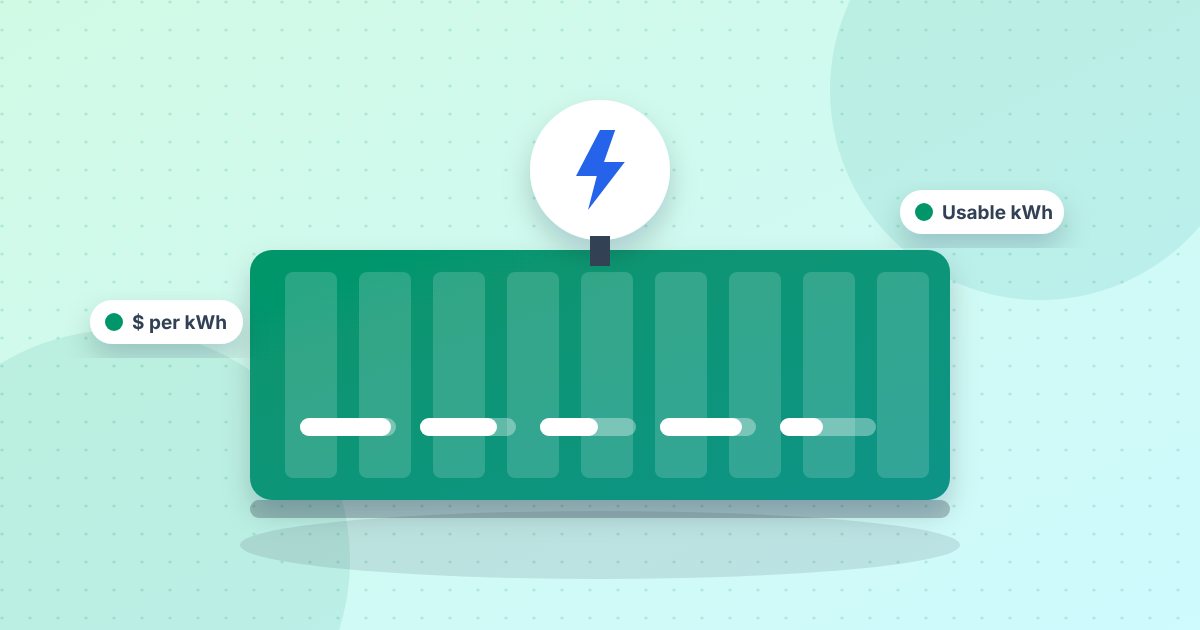
A battery quote is only comparable once you know what is inside the price. This guide shows how to compare storage offers by usable kWh, scope of supply, warranty and delivery.
In this article
How do you compare battery storage prices?
Compare battery storage offers by price per usable kWh, on the same scope of supply and the same delivery terms. The headline price per kWh on a datasheet often refers to nameplate capacity, and the real number you pay for depends on what the quote includes, how much of the capacity you can actually use, and where the goods are delivered.
Nameplate vs usable capacity
Nameplate capacity is the total energy the battery is built to hold. Usable capacity is what you can draw in normal operation, after limits set by the battery management system. If one offer is 1,000 kWh nameplate with 90% usable and another is 950 kWh nameplate with 95% usable, the second may deliver more energy for the money. Always ask for usable kWh and the conditions it is measured under.
Check the scope of supply
Two quotes may cover very different things. Ask whether the price includes:
- Battery modules, racks and the enclosure or container.
- Battery management system and controls.
- Power conversion: inverter or PCS. See how to choose an inverter.
- Thermal management and fire protection.
- Commissioning, monitoring software and training.
- Transport, installation and site work.
Round-trip efficiency and warranty
Round-trip efficiency tells you how much of the energy you put in comes back out. Warranty terms describe how long the system is covered and what capacity it must still deliver at the end. Look for the number of years, the guaranteed remaining capacity and any limit on total energy throughput or cycles per year. A longer warranty with strict throughput limits may be worth less than it looks.
Chemistry and certifications
Most stationary storage today uses lithium iron phosphate (LFP), which is valued for stability and cycle life. See LFP vs NMC for the trade-offs. Ask for the safety and transport test reports and certifications for the battery and the full system. Our guide to certifications and documents lists what to request.
Delivery terms and currency
A price quoted ex-works is not the price delivered to your site. Add freight, insurance, import duties and taxes, and the cost of unloading. Check the currency too: a USD offer and a CAD offer are not comparable until converted at the same rate. Our guides on Incoterms and importing into Canada cover this in more detail.
A simple comparison sheet
- Write each offer's price, currency and delivery term.
- Convert to the same currency and add freight and duties to reach a landed price.
- Divide by usable kWh to get a landed price per usable kWh.
- Note round-trip efficiency, warranty and what is excluded.
- Ask the supplier to confirm the numbers in writing.
See price per kWh in listings
On TradYard, storage listings show their specs and a price per kWh so you can start the comparison quickly. Browse storage in the shop, or ask suppliers for quotes with an RFQ.
Frequently Asked Questions
What is a good price per kWh for battery storage?
There is no single number. It depends on chemistry, scale, scope of supply and delivery terms. Compare landed price per usable kWh across offers.
What is the difference between kWh and usable kWh?
kWh on the nameplate is the total capacity. Usable kWh is the energy you can actually use in normal operation.
Does the battery price include the inverter?
Not always. Check whether the offer covers power conversion, controls and installation.
How long should a battery warranty be?
Warranty lengths vary. Look at the years covered, the guaranteed remaining capacity and any throughput limits.
Should I request samples or test reports?
Ask for test reports and certificates for any storage product, and for large orders agree on acceptance tests in writing.
Written by
Amir Oboudi
October 18, 2026
Related Articles
View all
How to Sell Energy Equipment on TradYard: A Supplier's Guide to Listings, Documents and Deals
Factories, distributors and surplus sellers can reach buyers on TradYard. Here is how to apply, build a listing buyers trust, host a live factory tour and handle quotes and deals.

How Surplus and Used Energy Equipment Auctions Work: A Buyer's Guide
Auctions can put surplus and used energy equipment in reach at a lower price, but only if you read the lot, set a limit and plan freight. Here is the process, step by step.
Backup Power for Commercial Sites: Generators, UPS and Batteries Compared
Generators, UPS units and batteries solve different parts of the backup problem. Here is how they compare and how to combine them for a commercial site.
Stay in the Loop
Get weekly market insights, auction alerts, and expert tips delivered to your inbox.
Unsubscribe anytime. No spam.